
Can-Am Defender vs. Commander: Which Should You Buy?

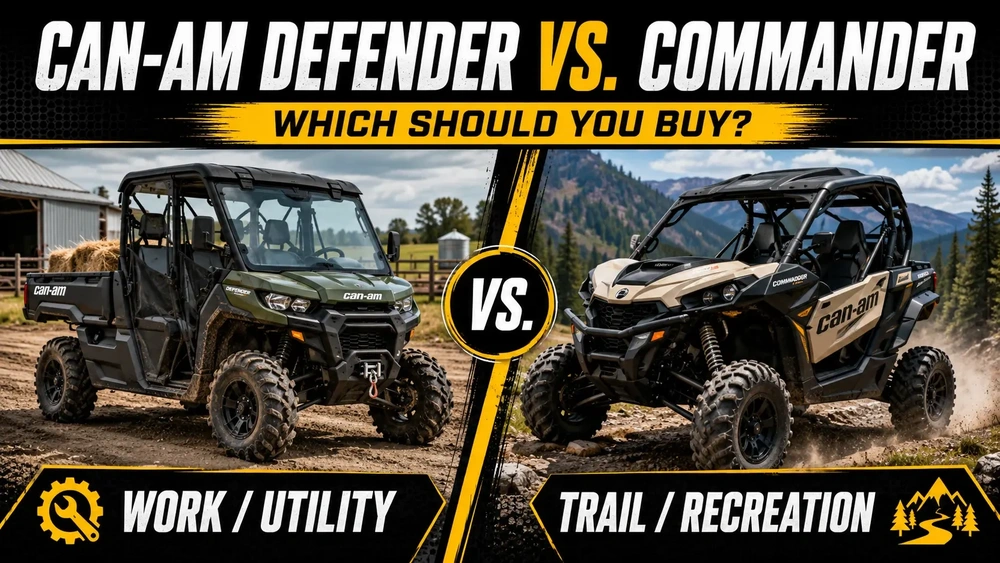
The Can-Am Defender and Can-Am Commander are both capable side-by-sides, but they are designed around different priorities.
The Defender is primarily a work-focused utility vehicle. It offers bench seating, greater towing and cargo-box capacity, work-oriented drive modes and configurations designed for farming, hunting, property maintenance and commercial use.
The Commander is a recreational side-by-side that retains enough cargo and towing ability to handle jobs around a cottage or property. It has sportier seating, more aggressive suspension and an available 100-horsepower engine for riders who place greater emphasis on trail performance.
For buyers in Kingston, Napanee, Belleville, Brockville, Gananoque and throughout Eastern Ontario, the right choice depends on whether your side-by-side will spend more time working, exploring trails or doing a combination of both.
Can-Am Defender vs. Commander at a Glance
| Feature | 2026 Can-Am Defender | 2026 Can-Am Commander |
|---|---|---|
| Canadian starting MSRP | $15,899 | $18,999 |
| Engine options | 52, 65 or 82 hp; separate HD11 models offer 95 hp | 52 or 100 hp |
| Standard seating | Bench seating for up to 3 | Bucket seating for 2 |
| MAX seating | Up to 6 | Up to 4 |
| Towing capacity | Up to 2,500 lb | Up to 2,000 lb |
| Cargo-box capacity | Up to 1,000 lb | Up to 600 lb |
| Primary focus | Work and utility | Recreation and trail riding |
| Best suited for | Farming, hunting, hauling and property maintenance | Trails, cottage use and recreational riding |
Canadian prices are manufacturer starting MSRPs and can change according to package, engine and equipment. Transportation, preparation, taxes, licensing and accessories may be additional.
The Quick Answer
Choose the Can-Am Defender when you want:
- A side-by-side primarily used for work
- Greater towing and cargo capacity
- Bench seating for three people
- A six-seat MAX configuration
- Work-focused driving modes
- Available enclosed-cab and HVAC packages
- Better suitability for farming, hunting and snow removal
Choose the Can-Am Commander when you want:
- A more recreational and performance-oriented machine
- More responsive trail handling
- An available 100-horsepower engine
- Individual bucket seats
- Greater suspension travel on selected packages
- A machine that can work during the week and hit the trails on weekends
The Defender is the stronger work vehicle. The Commander is the better work-and-play crossover.
What Is the Main Difference Between the Defender and Commander?
The main difference is not simply horsepower. It is how each vehicle is designed to be used.
Can-Am classifies the Defender as a utility-recreational side-by-side built around hauling, towing and task-based performance. The Commander is placed in the recreational category and is designed to combine a dumping cargo box with more performance-oriented trail capability.
The Defender’s layout feels similar to a compact off-road work truck. Its bench seat provides room for up to three people, while the cargo box is designed to carry tools, firewood, feed, landscaping materials and other heavy loads.
The Commander feels more like a recreational off-road vehicle with added utility. Its bucket seats, sport-oriented driving mode and available 1000R engine create a more engaging trail experience, but it still provides a dumping cargo box, Turf mode and a 2,000-pound towing rating.
Price: Is the Defender or Commander More Affordable?
The 2026 Can-Am Defender starts at $15,899 in Canada, while the 2026 Commander starts at $18,999. The difference reflects their entry configurations: the base Defender uses the HD7 engine and focuses on essential utility, while the Commander includes recreational features such as bucket seating, Dynamic Power Steering, Sport and Eco modes and premium half doors.
However, package selection can quickly become more important than the base price.
A Defender equipped with an enclosed cab, heating, air conditioning, power windows, a winch and a larger engine can cost considerably more than a basic Commander. Similarly, a Commander XT-P, X mr or four-seat MAX package can move well beyond the entry price.
The better value depends on your intended use. Paying for the Commander’s extra trail performance may not make sense when the machine will primarily haul materials. Paying for a fully enclosed Defender may be worthwhile when it will be used throughout an Ontario winter.
Engine and Horsepower Comparison
The standard Defender lineup offers several Rotax engine choices:
- HD7: 52 horsepower and 42 lb-ft of torque
- HD9: 65 horsepower and 59 lb-ft of torque
- HD10: 82 horsepower and 69 lb-ft of torque
The separate 2026 Defender HD11 platform uses a 999 cc three-cylinder Rotax engine producing 95 horsepower and 70 lb-ft of torque.
The Commander offers two primary engines:
- 700: 52 horsepower and 42 lb-ft of torque
- 1000R: 100 horsepower from a 976 cc V-twin
Both Commander engines include Sport and Eco modes, allowing the driver to change the throttle and transmission response.
The Commander 1000R is the clear choice when acceleration and recreational performance are the priorities. Its 100 horsepower gives it a more aggressive personality on open trails.
The Defender’s engines are tuned around controlled power, torque and long work periods. Even when comparing the 82-horsepower HD10 or 95-horsepower HD11 with the Commander 1000R, the Defender’s overall design remains focused more heavily on towing, hauling and low-speed control.
Is the Commander 700 Powerful Enough?
The Commander 700 uses the same basic 52-horsepower output listed for the Defender HD7, but it is still capable of recreational trail riding, towing and light property work. It can be a sensible choice for owners who do not require the acceleration of the 1000R and want to keep the purchase price lower.
The 700 may be enough when you plan to:
- Ride at moderate speeds
- Explore cottage and woodland trails
- Tow smaller loads
- Carry basic camping or hunting equipment
- Use the machine for occasional property maintenance
Choose the 1000R when you regularly ride faster, encounter steep terrain, carry several passengers or simply want the Commander’s full performance potential.
Towing Capacity
The Defender has the advantage when towing.
Standard 2026 Defender models are rated to tow up to 2,500 pounds, while the Commander is rated for up to 2,000 pounds. Both provide a two-inch hitch receiver on applicable configurations.
That extra 500 pounds can matter when pulling:
- A utility trailer
- Firewood
- Landscaping materials
- Farm equipment
- Hunting equipment
- Boats or personal watercraft around private property
- Ice-fishing equipment
The Commander’s 2,000-pound capacity remains substantial for a recreational side-by-side. It is more than sufficient for many cottage, hunting and property-maintenance jobs. The Defender is the better choice when heavy towing will be frequent rather than occasional.
Always calculate the trailer’s loaded weight rather than relying only on its empty weight, and stay within the rating for the specific vehicle, hitch and equipment configuration.
Cargo-Box Capacity
The Defender also carries more weight in its cargo box.
Current Defender specifications list a 1,000-pound cargo-box capacity, with a box measuring approximately 38 by 54.5 by 12 inches on conventional two-row and single-row configurations. The Commander’s dumping cargo box measures approximately 29.5 by 45.2 by 10.6 inches and carries up to 600 pounds.
The Defender’s larger box is more appropriate for:
- Bags of soil or feed
- Firewood
- Tools and construction equipment
- Gravel and landscaping materials
- Hunting supplies
- Farm and property-maintenance equipment
The Commander’s box is still useful for coolers, camping gear, chainsaws, tools and lighter loads. It also includes LinQ mounting points that make it easier to secure compatible accessories.
A Defender PRO or Defender 6x6 takes utility even further with an extended modular cargo box measuring approximately 72 by 54.5 inches on selected packages.
Which One Is Better on Trails?
The Commander is generally better for recreational trail riding.
Its driver and passenger sit in individual bucket seats rather than sharing a bench. Available 1000R packages provide 100 horsepower, and selected versions add arched suspension components, longer travel, premium FOX shocks, larger tires and Smart-Lok front-differential technology.
The Commander XT-P is particularly focused on performance, with equipment including:
- A 1000R engine
- Smart-Lok front differential
- FOX 2.5 Podium shocks
- 30-inch tires
- Beadlock wheels
- A 4,500-pound winch
The X mr package is designed more specifically for mud riding, with dedicated gearing, traction modes and mud-focused equipment.
The Defender can still handle trails, especially in HD9, HD10 and HD11 configurations. It is a good choice for relaxed riding, hunting access and reaching remote property. It simply feels more like a utility machine than a sport-oriented side-by-side.
Suspension and Ride Quality
Standard Defender models provide approximately 10 inches of front and rear suspension travel, while wider or more heavily equipped packages can offer around 12 inches. The design prioritizes stability, load carrying and comfort during long work periods.
Commander suspension varies by package and engine. Selected 1000R models provide increased travel, arched A-arms and greater ground clearance. The Commander XT-P upgrades to adjustable FOX shocks, helping the vehicle absorb rough terrain at a more recreational pace.
Choose the Commander when you want the machine to feel lively and controlled during faster trail riding. Choose the Defender when your priorities are predictable low-speed handling, carrying weight and comfortably travelling across uneven property.
Which Is More Comfortable?
Comfort depends on the type of riding you do.
The Defender uses a VERSA-PRO bench seat. Its passenger sections can flip upward to create additional interior storage or floor space, and selected packages add a more supportive bolster design and an adjustable driver’s position.
The Commander uses individual bucket seats. This arrangement holds occupants more securely during cornering and uneven trail riding. It also creates a sportier, more driver-focused environment.
For recreational riding, many people will prefer the Commander’s bucket seats. For work, frequent entry and exit and carrying three occupants across one row, the Defender’s bench is more practical.
Enclosed Cabs and Year-Round Use
The Defender provides the strongest factory options for an enclosed cab.
Depending on the package, equipment can include:
- A full hard roof
- Locking doors
- Power windows
- A glass windshield
- Wiper and washer systems
- A rear glass window
- Heating and ventilation
- Full heating, ventilation and air conditioning
The Defender DPS CAB HD10, Defender HD11 CAB and Limited packages are designed for owners who need to work through summer heat, rain, wind and winter conditions.
The Commander can be fitted with roofs, windshields, doors and other weather-protection accessories, but it does not provide the same range of work-focused factory cab configurations.
For year-round property maintenance or snow plowing in Eastern Ontario, the Defender has the clear comfort advantage.
Defender vs. Commander for Snow Plowing
The Defender is generally the better snow-plowing choice.
Its work-oriented drivetrain modes, speed limiter, available enclosed cab, HVAC systems, higher towing rating and larger cargo capacity make it better suited to repeated winter work. Selected XT packages also include a 4,500-pound winch, which can be used with compatible plow equipment.
A Commander can also operate a compatible snowplow and may be perfectly adequate for clearing a cottage driveway or smaller property. Its 650-watt magneto supports electrical accessories, while Turf mode can reduce unnecessary damage when manoeuvring on sensitive surfaces.
Choose the Defender for frequent or demanding snow removal. Choose the Commander when plowing is a secondary job and trail riding remains the main purpose.
Which Is Better for Hunting?
Both models can make excellent hunting vehicles.
The Defender is better when you need maximum cargo capacity, quiet and controlled low-speed operation, bench seating or an enclosed cab. Its larger box provides more room for equipment, and the higher towing rating helps when pulling a trailer into remote property.
The Commander is better when reaching the hunting area involves longer or more challenging recreational trails. It still provides a 600-pound dumping box, 2,000-pound towing rating and two- or four-seat configurations.
A Defender XT or HD11 may suit hunters who prioritize utility. A Commander XT or XT-P may suit those who want a more entertaining machine during the rest of the year.
Two Seats, Three Seats, Four Seats or Six?
The standard Defender uses a bench layout for up to three occupants. Defender MAX configurations add a second bench and provide room for up to six.
The standard Commander provides two bucket seats. Commander MAX models add a second row for a total of four bucket seats.
Choose based on how often every seat will actually be used:
Defender three-seat: Work crews, couples with a child or owners who appreciate a wide bench.
Defender MAX six-seat: Families, larger work crews and hunting groups.
Commander two-seat: Couples, solo riders and buyers wanting the most compact recreational configuration.
Commander MAX four-seat: Families and groups who want a recreational trail machine.
MAX versions are longer and require additional turning, storage and trailer space, so buyers should not automatically select one unless the additional seats are genuinely needed.
Defender HD7, HD9, HD10 or HD11?
Choose the HD7 when affordability and moderate property work are the priorities. Its 52-horsepower engine is suitable for basic hauling, transportation and lighter towing.
Choose the HD9 when you want additional torque and performance without moving to the most expensive packages. It produces 65 horsepower and 59 lb-ft of torque.
Choose the HD10 when you regularly tow, haul, plow or carry multiple passengers. Its 82 horsepower and 69 lb-ft provide more capability for demanding work.
Choose the HD11 when you want the Defender’s newest and most powerful work-focused platform. Its 999 cc three-cylinder engine produces 95 horsepower and 70 lb-ft, while the redesigned vehicle adds updated suspension, technology and interior features.
Commander 700 or 1000R?
Choose the Commander 700 when:
- You want a lower purchase price
- Your riding pace is moderate
- The machine will perform lighter jobs
- Fuel and operating costs matter more than maximum acceleration
- You are buying your first side-by-side
Choose the Commander 1000R when:
- Recreational performance is a priority
- You ride in steep or demanding terrain
- You frequently carry passengers and cargo
- You want access to XT-P or X mr equipment
- You prefer stronger acceleration
The 700 produces 52 horsepower, while the 1000R produces 100 horsepower.
Which One Is Better for Cottage Ownership?
The Commander may be the better all-around cottage machine when trail rides and recreation are a major part of ownership.
It can tow a trailer, carry 600 pounds in its dumping box and handle jobs such as moving firewood, transporting tools or taking supplies to the dock. Once the work is done, it provides a sportier ride than the Defender.
The Defender is better when the property demands serious work. It provides more cargo capacity, more towing capability, room for three people across the front and better enclosed-cab choices.
A simple way to decide is to consider how the machine will spend most of its hours:
- Mostly chores with occasional rides: Defender
- Mostly riding with occasional chores: Commander
- Frequent heavy work in every season: Defender with cab
- Family trail riding: Commander MAX
- Transporting large groups or work crews: Defender MAX
Final Verdict: Can-Am Defender or Commander?
Buy the Can-Am Defender when work comes first. Its 2,500-pound towing capacity, 1,000-pound cargo-box rating, bench seating and available enclosed cabs make it the better choice for farming, hunting, property maintenance, hauling and winter use.
Buy the Can-Am Commander when recreation comes first but you still need practical utility. Its available 100-horsepower engine, bucket seats, trail-focused suspension and 600-pound dumping box make it one of the most versatile work-and-play side-by-sides in the Can-Am lineup.
The simplest way to choose is to ask:
Will you use your side-by-side mainly to complete jobs or to enjoy the trails?
For serious work, choose the Defender. For trail performance with useful work capability, choose the Commander.
Frequently Asked Questions
Is the Can-Am Commander faster than the Defender?
A Commander equipped with the 1000R engine produces 100 horsepower, more than the 52-, 65- and 82-horsepower engines in the conventional Defender lineup and slightly more than the 95-horsepower Defender HD11. Actual performance depends on the package, vehicle weight, passengers, cargo and terrain.
Which can tow more, the Defender or Commander?
The Defender is rated to tow up to 2,500 pounds, while the Commander is rated for up to 2,000 pounds.
Which has the bigger cargo box?
The Defender carries up to 1,000 pounds in its standard cargo box, compared with up to 600 pounds in the Commander. Defender PRO and 6x6 configurations also offer a substantially longer cargo platform.
Is a Commander good for farm work?
The Commander can handle lighter farm and property jobs with its dumping cargo box, 2,000-pound towing rating and selectable Turf mode. The Defender is better suited to frequent heavy work because it carries and tows more.
Is the Defender good for trail riding?
Yes. The Defender can handle recreational trails, hunting routes and cottage access. Riders seeking faster, more aggressive trail performance will generally prefer the Commander.
Can you get a four-seat Commander?
Yes. Commander MAX models provide four bucket seats. Defender MAX models use two bench rows and can accommodate up to six occupants.
Compare Can-Am Defender and Commander Models at Cartronics Powersports
Visit Cartronics Powersports at 538 O’Connor Drive in Kingston to compare Can-Am Defender and Commander models in person. The team can help you select the right engine, seating configuration, cab, accessories and financing options for your property, work requirements and riding style.
Cartronics Powersports serves side-by-side buyers from Kingston, Napanee, Belleville, Brockville, Gananoque and communities throughout Eastern Ontario.
Prices, inventory, specifications, colours, promotions and packages can change. Confirm current details with Cartronics Powersports before purchasing.