
Do You Need Snowmobile Studs? Ontario Guide

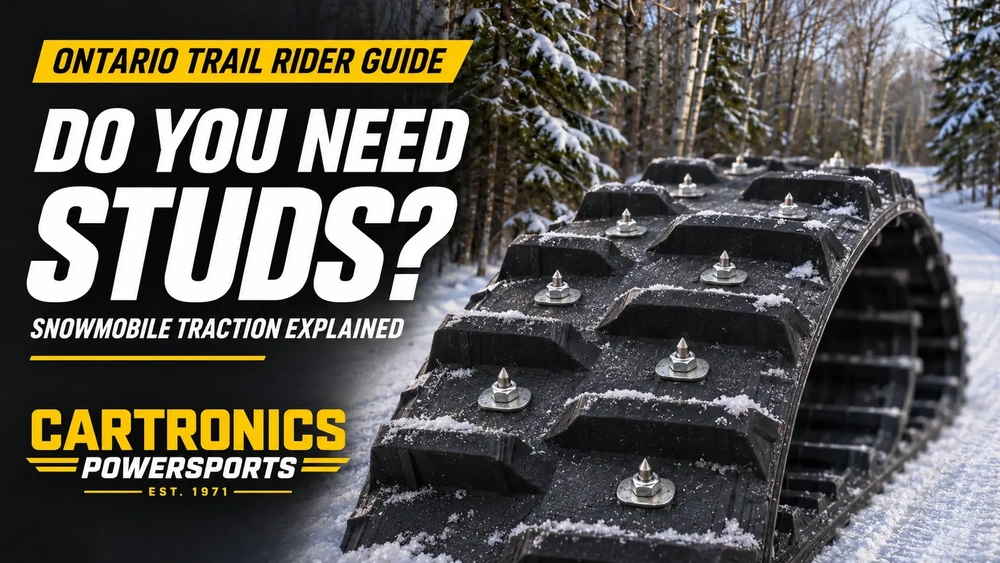
Do You Need Studs on Your Snowmobile? A Guide for Ontario Trail Riders
Snowmobile studs are worth considering if you regularly encounter icy or hard-packed trails. They can improve the track’s grip when rubber lugs have less to bite into. Whether they are the right choice depends on your snowmobile, its track, your ski carbides and the conditions you ride most often.
For riders around Kingston and Eastern Ontario, the decision is about more than adding a bag of studs. An unstudded track, a factory prestudded track and a conventional stud setup offer different benefits and responsibilities. Here is what to compare before spending money.
What Do Snowmobile Studs Actually Do?
Snowmobile studs add metal traction points to the track. On conventional trail studs, carbide tips help penetrate firm or icy surfaces, giving the track more bite during acceleration and braking.
That can be useful on polished trail sections, icy inclines and snow that has thawed and refrozen. Studs are a traction tool for these conditions; they are not a substitute for a track profile suited to softer snow.
Additional grip does not eliminate sliding or guarantee a particular stopping distance. Your speed, available traction and visibility still need to guide how you ride.
Conventional Studs vs. Factory Prestudded Tracks
These two approaches are often discussed as though they are the same. Understanding the difference helps you compare both a new snowmobile and an upgrade to the sled you already own.
| Track setup | How it works | What to consider |
|---|---|---|
| Unstudded track | Rubber lugs provide traction without metal studs. | No stud hardware to maintain, but less bite on ice than a suitable studded setup. |
| Factory prestudded track | Small traction studs are embedded in the lugs during manufacturing. | Added icy-surface grip without installing conventional stud nuts and backing plates. Track inspection and fitment checks still apply. |
| Conventional studded track | Studs mount through an approved track belt with the specified retaining hardware. | Requires the correct studs, pattern, clearance and maintenance for the exact application. |
Ice Ripper XT is an example of a factory prestudded track. Its embedded traction points are different from a conventional bolt-through stud installation. If your sled already has an Ice Ripper XT, you already have a form of studded traction.
Prestudded designs also differ from one another. Lug shape, stud arrangement and track construction affect performance, so the word “prestudded” does not mean every track provides the same grip.
When Studs Make Sense for Ontario Trail Riding
Start with the conditions you actually encounter. If your usual routes include firm snow and recurring icy patches, comparing approved traction options is worthwhile. A relaxed trail rider may value extra braking traction just as much as someone shopping for performance.
If you are buying a new sled, ask which track comes on the exact unit. If you are upgrading an existing machine, identify its current track before choosing hardware. A used snowmobile may have a replacement track that differs from its original specification.
For a rider happy with an existing factory prestudded track, the next step may simply be inspecting its condition and checking the ski carbides. More hardware is not automatically the best answer.
Why Your Ski Carbides Matter Too
The track provides traction at the rear, while the carbide runners beneath the skis influence grip at the front. The two need to work together.
Increasing rear grip without an appropriate ski-runner setup can make the sled push wide in a turn. The opposite imbalance can make the rear slide outward. The aim is a balanced combination for the machine and rider, rather than choosing studs and carbides independently.
Have worn runners assessed as part of the same conversation. Track studs cannot correct every steering complaint.
How Many Studs Do You Need, and How Long Should They Be?
There is no universal quantity or length for every trail sled. A 129-, 137- or 146-inch track measurement is only one part of the selection.
The correct application also depends on the track’s construction, lug height, approved stud pattern, available clearance and matching ski runners. A stud kit listed for one track may be unsuitable for another of the same length.
Use the snowmobile, track and stud manufacturers’ recommendations for your exact combination. Do not choose a stud length from the track-length number alone.
Track Approval and Tunnel Protection Come First
Before installation, confirm that the track is approved for studding and is in suitable condition. Single-ply and two-ply tracks can require different studs, retainers and templates; their hardware should not be treated as interchangeable.
BRP recommends dealer installation on approved pre-patterned tracks using the specified products and procedures. Clearance and the correct tunnel protection are essential because an unsuitable setup can damage the tunnel or heat exchangers.
Factory prestudded tracks also need to meet the snowmobile manufacturer’s protection requirements. Check the exact model and track combination rather than assuming that smaller embedded studs remove the need for protectors.
Maintenance and Costs to Include in Your Decision
Conventional studs add components that need attention. Follow the applicable inspection and torque-check instructions, including checks of the studs, nuts and support plates. Track tension and alignment remain part of normal maintenance.
Check the track itself for damaged lugs, cracks and stud tear-outs. A torn stud hole compromises the belt; replacing the missing stud alone does not repair that damage. Have the track assessed before riding.
When comparing prices, ask for a complete quote covering the approved hardware, installation, any required tunnel protection and any ski-runner changes. Also consider protection for trailer decks and garage floors where metal traction components can cause wear.
Snowmobile Stud FAQs
Can I add conventional studs to an Ice Ripper XT?
Do not assume it is approved simply because it already has embedded studs. Additional studding is a separate modification. Confirm the exact track, approved pattern, hardware and snowmobile clearance before making changes.
Does a taller-lug track mean I do not need studs?
Lug height and metal traction points address different characteristics. Taller rubber lugs are not equivalent to carbide tips on an icy surface. Choose the track profile for your riding conditions, then assess approved traction options separately.
Is a prestudded track maintenance-free?
No. It avoids the separate nuts and backing plates used by conventional studs, but the belt, lugs, embedded traction points and track adjustment still need inspection and care.
Get Snowmobile Traction Advice at Cartronics Powersports
Before you buy a stud kit or a replacement track, bring us your sled’s year and model, its current track details and a description of where you ride. That gives our team the information needed to help you compare suitable options.
Visit Cartronics Powersports at 538 O’Connor Drive in Kingston, or call 613-634-8044. Our parts department can help with fitment questions, and our service team can assess your current setup.
Getting the track, studs and ski carbides working together is the goal—so you can choose equipment that suits the way you ride.