Two-Stroke vs. Four-Stroke Snowmobiles: Which Is Better for Ontario Riders?

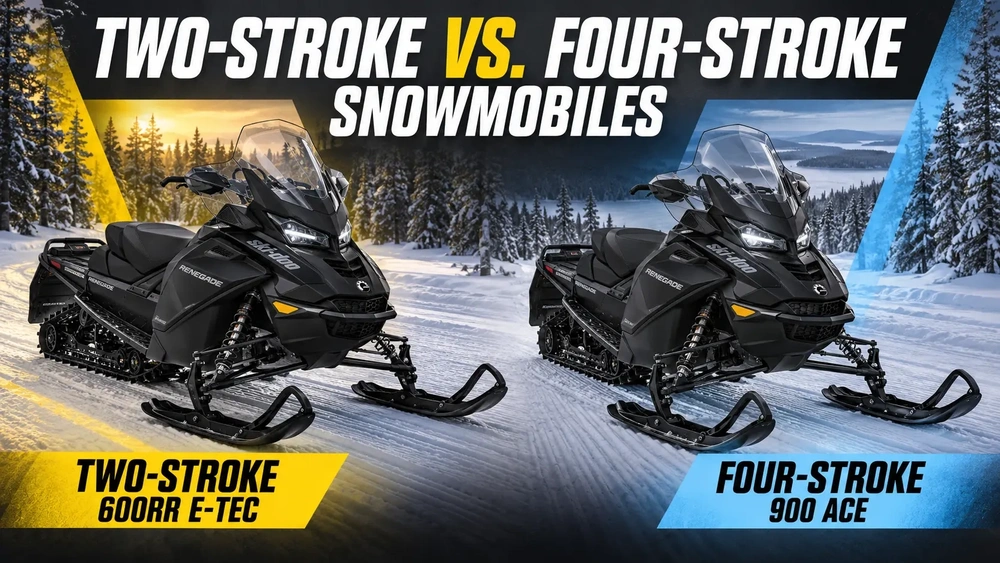
Choosing between a two-stroke and four-stroke snowmobile is one of the most important decisions a buyer will make.
Two-stroke engines are generally lighter, quicker to respond and popular with performance and off-trail riders. Four-stroke engines are known for smooth power, excellent fuel economy, low-maintenance ownership and comfortable long-distance riding.
Neither engine type is automatically better for everyone. The right choice depends on where you ride, how many kilometres you travel, whether you carry a passenger and how you want your snowmobile to feel.
For Ontario riders, that could mean everything from groomed OFSC trails and frozen lakes to cottage access, ice fishing, property maintenance and off-trail exploration.
This guide compares two-stroke and four-stroke snowmobiles to help you decide which engine is best for your winter adventures.
Two-Stroke vs. Four-Stroke Snowmobiles: Quick Comparison
| Category | Two-stroke snowmobile | Four-stroke snowmobile |
|---|---|---|
| Weight | Generally lighter | Generally heavier |
| Throttle response | Fast and immediate | Smooth and controlled |
| Power-to-weight ratio | Excellent | Depends on engine and turbocharging |
| Fuel economy | Good on modern engines | Usually better |
| Engine oil | Uses injection oil while riding | Requires periodic oil and filter changes |
| Sound | Sharper, higher-revving exhaust note | Deeper and generally quieter |
| Trail handling | Light and responsive | Stable and planted |
| Long-distance touring | Capable, especially modern E-TEC models | Particularly well suited |
| Deep snow | Often preferred because of lower weight | Additional weight can be noticeable |
| Utility work | Available and capable | Strong low-speed power makes it a popular choice |
| Passenger riding | Available on several models | Excellent for smooth, comfortable touring |
| Best suited to | Performance and active riding | Touring, utility and high-mileage riding |
These are general differences. Snowmobile design, suspension, track, gearing and engine size can be just as important as whether the engine is a two-stroke or four-stroke.
What Is a Two-Stroke Snowmobile Engine?
A two-stroke engine completes its combustion cycle with two piston movements. This allows it to produce a considerable amount of power from a relatively compact and lightweight design.
Traditional two-stroke engines developed a reputation for smoke, noise and high fuel consumption. Modern direct-injected engines, such as the Rotax E-TEC family, are significantly more advanced.
Modern two-stroke snowmobiles offer:
- Electronic or direct fuel injection
- Precisely controlled oil delivery
- Strong fuel economy
- Cleaner operation than older designs
- Excellent throttle response
- High power from a relatively small engine
- Lightweight construction
Current Ski-Doo two-stroke options include engines such as the Rotax 600 EFI, 600RR E-TEC, 850 E-TEC and 850 E-TEC Turbo R. Engine availability depends on the snowmobile model and package.
What Is a Four-Stroke Snowmobile Engine?
A four-stroke engine completes its combustion cycle with four piston movements. It has a dedicated engine-oil system similar to what is found in a car, ATV or motorcycle.
Four-stroke snowmobile engines are known for smooth power delivery, strong fuel economy and low-maintenance operation.
Current Ski-Doo four-stroke options include:
- Rotax 600 ACE
- Rotax 900 ACE
- Rotax 900 ACE Turbo
- Rotax 900 ACE Turbo R
These engines range from approachable and economical options to extremely powerful turbocharged engines. Choosing a four-stroke does not necessarily mean giving up performance. The 900 ACE Turbo R produces performance comparable to the most powerful two-stroke engines, but with a different feel and power delivery.
Which Engine Is Lighter?
Two-stroke engines are generally lighter because they use fewer moving components and do not require the same type of dedicated engine-oil system as a four-stroke.
That reduced weight can affect how the entire snowmobile feels.
A lighter snowmobile is often:
- Easier to manoeuvre
- More responsive when changing direction
- Easier to control in deep snow
- Less tiring during aggressive riding
- Easier to recover when stuck
- More playful on uneven terrain
The difference is particularly noticeable when comparing naturally aspirated two-stroke engines with larger turbocharged four-strokes.
Four-stroke snowmobiles often feel more planted and stable. That additional weight may be beneficial on groomed trails, especially during long rides or when travelling at a steady pace.
Which Has Better Performance?
Two-strokes have traditionally been the preferred choice for riders who want immediate acceleration and a strong power-to-weight ratio.
A performance two-stroke responds quickly when the throttle is pressed. This makes it well suited to:
- Aggressive trail riding
- Corner-to-corner acceleration
- Deep-snow riding
- Technical terrain
- Jumps and bumps
- Active crossover riding
Ski-Doo uses two-stroke engines throughout performance-oriented models such as the MXZ, Summit, Freeride and Backcountry.
However, modern turbocharged four-stroke engines can also produce exceptional power. The Rotax 900 ACE Turbo and 900 ACE Turbo R deliver strong torque and acceleration while retaining the smooth characteristics associated with a four-stroke.
The difference is primarily how the performance is delivered. A two-stroke normally feels lighter and more immediate, while a powerful four-stroke feels muscular, smooth and planted.
Which Is Better on Ontario Snowmobile Trails?
Both engine types can be excellent for Ontario trail riding.
A two-stroke may be better if you enjoy:
- Quick acceleration
- Responsive handling
- Riding aggressively through corners
- A lighter and more active snowmobile
- Frequently moving between trails and unpacked snow
A four-stroke may be better if you enjoy:
- Long-distance trail rides
- Consistent cruising speeds
- Smooth and predictable power
- Better fuel economy
- A quieter riding experience
- A stable and planted feel
The Renegade is particularly useful for comparing the two engine types because selected versions are available with both two-stroke E-TEC and four-stroke ACE engines.
A two-stroke Renegade emphasizes quick response and a lighter feel. A four-stroke Renegade is especially attractive to riders who cover significant distances and prioritize smoothness and fuel economy.
Which Has Better Fuel Economy?
Four-stroke snowmobiles generally have the advantage in fuel economy, particularly naturally aspirated engines such as the Rotax 600 ACE and 900 ACE.
This can be important for Ontario riders who travel long distances between fuel stops. Better fuel economy can provide:
- Greater riding range
- Fewer fuel stops
- Lower operating costs
- More confidence on remote routes
- Easier planning for long trail days
Ski-Doo reports fuel consumption as low as approximately 8 L/100 km for the 600 ACE under its internal trail-testing conditions. Actual fuel consumption will vary depending on temperature, snow conditions, speed, track, cargo, elevation and riding style.
Modern E-TEC two-strokes can also deliver respectable fuel economy. A rider who frequently uses full throttle will consume more fuel regardless of engine type.
Turbocharged engines can provide good efficiency during relaxed riding, but fuel consumption will increase when their available power is used regularly.
Which Requires More Maintenance?
Both engine types require routine maintenance, but the maintenance is different.
Two-stroke snowmobile maintenance
A two-stroke engine uses injection oil as it operates. The oil reservoir must be monitored and refilled with the correct product.
Typical maintenance considerations include:
- Checking and adding injection oil
- Inspecting spark plugs
- Inspecting the fuel system
- Following required storage procedures
- Checking the drive belt and clutches
- Monitoring engine performance
Modern E-TEC systems precisely control how much injection oil is used. However, owners should still carry enough oil for longer trips and check the reservoir regularly.
Four-stroke snowmobile maintenance
A four-stroke does not consume injection oil during normal operation. Instead, its engine oil and filter must be changed according to the maintenance schedule.
Typical maintenance considerations include:
- Checking the engine-oil level
- Periodic engine oil and filter changes
- Inspecting the cooling system
- Checking the battery
- Inspecting the drive belt and clutches
- Following scheduled engine maintenance
Four-stroke engines are often described as low-maintenance, but that does not mean maintenance-free.
Both two-stroke and four-stroke snowmobiles require inspection of the track, suspension, chaincase, brakes, skis, carbides, steering and electrical systems.
Which Engine Lasts Longer?
Four-stroke engines are frequently chosen by high-mileage riders because of their reputation for durability and long-term ownership.
Their smoother power delivery and lower operating speeds can make them attractive to riders who expect to accumulate a significant number of kilometres over several winters.
However, engine life cannot be determined by stroke type alone. Longevity also depends on:
- Proper warm-up
- Correct oil and fuel
- Maintenance history
- Storage practices
- Riding conditions
- Engine modifications
- Cooling
- Rider behaviour
- Previous damage
A well-maintained modern two-stroke can provide many seasons of dependable riding. A neglected four-stroke can still develop expensive problems.
When considering a used snowmobile, its condition and maintenance history may be more important than whether it has a two-stroke or four-stroke engine.
Which Is Quieter?
Four-stroke snowmobiles generally produce a deeper and less aggressive exhaust note. Many touring and utility riders find them more comfortable during long days on the trail.
Two-strokes typically produce a sharper, higher-revving sound. Modern E-TEC engines are considerably more refined than older two-strokes, but their sound and response remain part of their performance-oriented character.
Noise can be especially important if you:
- Ride with a passenger
- Travel through cottage areas
- Use a snowmobile for property maintenance
- Cover long distances
- Prefer a more relaxed riding experience
Regardless of engine type, the exhaust system should remain factory-compliant and in good condition. Excessive snowmobile noise can create conflicts with property owners and threaten continued trail access.
Which Is Better for Passenger Riding?
A four-stroke is an excellent choice for passenger riding because of its smooth power delivery, stable feel and comfortable cruising characteristics.
Models such as the Ski-Doo Grand Touring are designed around rider and passenger comfort and are available with ACE four-stroke engines.
An Expedition equipped with a passenger seat can also provide a strong combination of:
- Passenger comfort
- Cargo capacity
- Trail capability
- Utility performance
- Off-trail versatility
Two-stroke models can still carry passengers when properly equipped and rated to do so. The smoother characteristics of a four-stroke simply make it a popular choice for couples who regularly ride together.
Which Is Better for Ice Fishing and Cottage Use?
Four-stroke engines are particularly attractive for ice fishing, cottage transportation and property maintenance.
Advantages can include:
- Smooth low-speed operation
- Strong torque
- Good fuel economy
- Reduced injection-oil requirements
- Comfortable cruising
- A quieter exhaust note
Snowmobiles such as the Skandic, Expedition and Tundra are designed for utility and recreational use. Depending on the model, buyers may have a choice between two-stroke and four-stroke engines.
A two-stroke utility snowmobile can still be an excellent choice when lighter weight and off-trail manoeuvrability are priorities.
For example, a rider travelling through unpacked snow to reach a remote camp may prefer a lighter two-stroke. Someone towing equipment across a lake or maintaining a rural property may prefer the smooth torque of a four-stroke.
Which Is Better in Deep Snow?
Two-stroke engines are generally preferred for serious deep-snow riding.
Weight has an enormous effect when manoeuvring across steep or unpacked terrain. A lighter snowmobile is easier to lean, turn and recover when it becomes stuck.
That is why models such as the Ski-Doo Summit and Freeride are built around two-stroke power.
A four-stroke can travel through deep snow when paired with the appropriate track and chassis, but its additional weight may become more noticeable during technical riding.
Most Eastern Ontario riders spend more time on groomed trails, lakes and mixed terrain than in mountain-style deep snow. However, riders travelling into Northern Ontario or regularly exploring ungroomed areas may still benefit from a lighter two-stroke.
Which Is Better for Beginners?
Either engine type can work for a beginner. The most important considerations are manageable power, predictable handling, correct snowmobile sizing and proper training.
A naturally aspirated four-stroke such as the 600 ACE offers:
- Smooth power delivery
- Excellent fuel economy
- Approachable performance
- A predictable throttle
- Easy long-term ownership
A lower-powered two-stroke such as the 600 EFI offers:
- Lighter handling
- Straightforward performance
- A responsive feel
- A more affordable entry into selected models
A first-time rider does not necessarily need the most powerful engine available. A snowmobile that matches the rider’s ability and intended use will normally provide a safer and more enjoyable ownership experience.
Current Ski-Doo Two-Stroke Models
Ski-Doo uses two-stroke engines extensively in its performance, crossover and deep-snow lineups.
Depending on the package, two-stroke power can be found in models such as:
- Ski-Doo MXZ
- Ski-Doo Renegade
- Ski-Doo Backcountry
- Ski-Doo Summit
- Ski-Doo Freeride
- Ski-Doo Expedition
- Ski-Doo Skandic
- Ski-Doo Tundra
- Ski-Doo Summit Neo
- Ski-Doo MXZ Neo+
Engine availability varies by model and package.
Current Ski-Doo Four-Stroke Models
Four-stroke ACE engines are available in several trail, touring, crossover and utility snowmobiles.
Depending on the package, four-stroke power can be found in models such as:
- Ski-Doo Renegade
- Ski-Doo Grand Touring
- Ski-Doo Expedition
- Ski-Doo Skandic
- Ski-Doo Tundra
- Ski-Doo MXZ 200
Not every engine is offered in every snowmobile. Confirm current model, engine and package availability before ordering.
Which Snowmobile Engine Should You Choose?
Choose a two-stroke snowmobile if you prioritize:
- Lower weight
- Immediate throttle response
- Aggressive acceleration
- Active trail handling
- Deep-snow capability
- Off-trail manoeuvrability
- A more playful riding experience
Choose a four-stroke snowmobile if you prioritize:
- Fuel economy
- Long-distance trail riding
- Smooth power delivery
- Low-maintenance ownership
- Passenger comfort
- Utility work
- A stable and planted ride
- Reduced reliance on injection oil
If your needs fall somewhere between the two, compare both engine options in the same or similar chassis. The difference often becomes much clearer once you sit on the machines and discuss how you plan to ride.
Frequently Asked Questions
Are two-stroke snowmobiles faster than four-strokes?
Not necessarily. Two-strokes generally have a better power-to-weight ratio and quicker-feeling throttle response. However, turbocharged four-strokes such as the Rotax 900 ACE Turbo R can produce extremely strong performance.
Are four-stroke snowmobiles more reliable?
Four-strokes have a strong reputation for durability, particularly among high-mileage riders. Modern E-TEC two-strokes are also designed for reliable long-term use. Maintenance history and operating conditions remain extremely important.
Do two-stroke snowmobiles still require mixed fuel?
Modern oil-injected snowmobiles normally have a separate injection-oil reservoir, so owners do not manually mix oil into every tank of fuel. Always confirm the requirements for your particular snowmobile.
Do four-stroke snowmobiles use injection oil?
No. A four-stroke has a dedicated engine-oil system. The oil and filter must be changed according to the manufacturer’s maintenance schedule.
Are four-stroke snowmobiles too heavy for trail riding?
No. Many four-stroke snowmobiles are specifically designed for trail riding. The additional weight often creates a stable and planted feel, although riders who prefer extremely light handling may favour a two-stroke.
Which type gets better fuel economy?
Four-strokes generally provide better fuel economy, particularly naturally aspirated engines such as the 600 ACE and 900 ACE. Actual fuel consumption depends heavily on riding style and conditions.
Which engine is better for Ontario trails?
A four-stroke is an excellent choice for high-mileage touring and relaxed cruising. A two-stroke may be preferable for aggressive riders who value acceleration and lightweight handling. Both can perform extremely well on Ontario trails.
Which is better for towing?
Four-strokes are frequently chosen for towing because of their smooth torque and utility-focused operation. Track width, gearing, cooling and the snowmobile’s towing rating are also important.
Compare Two-Stroke and Four-Stroke Snowmobiles at Cartronics Powersports
The best engine is the one that matches how and where you ride.
Cartronics Powersports carries Ski-Doo snowmobiles with two-stroke E-TEC and four-stroke ACE engine options. Our team can help you compare performance, weight, fuel requirements, maintenance, comfort, available packages and financing options.
Cartronics Powersports is located at 538 O’Connor Drive in Kingston, Ontario, serving snowmobile riders from Kingston, Napanee, Belleville, Brockville, Gananoque and surrounding Eastern Ontario communities.
Explore our current Ski-Doo inventory online call us at 613-634-8044, or visit the dealership to find the right snowmobile for your next Ontario winter.